The Military System That Defined Discipline and Heavy Infantry Warfare
Origins of the Spartan Hoplite System
The Spartan Hoplites emerged in ancient Greece as one of the most disciplined and feared heavy infantry forces in history. Unlike other Greek city-states, Sparta transformed warfare into a state-controlled profession,
where military service was not a duty—but a way of life.
Spartan society was organized entirely around war. From birth, male citizens were
evaluated for physical strength, and those deemed unfit were removed from the system.
This harsh selection ensured that only the strongest entered the
Spartan military structure.
The Agoge: Training Warriors From Childhood
At the age of seven, Spartan boys entered the Agoge, a state-run training program
designed to forge elite soldiers through hardship, discipline, and obedience.
- Survival training with minimal resources
- Endurance and formation combat drills
- Psychological conditioning and obedience
- Emphasis on unit cohesion over individuality
This system produced warriors who valued collective survival over personal life,
a defining principle of Spartan hoplite warfare.
Equipment and Battlefield Role
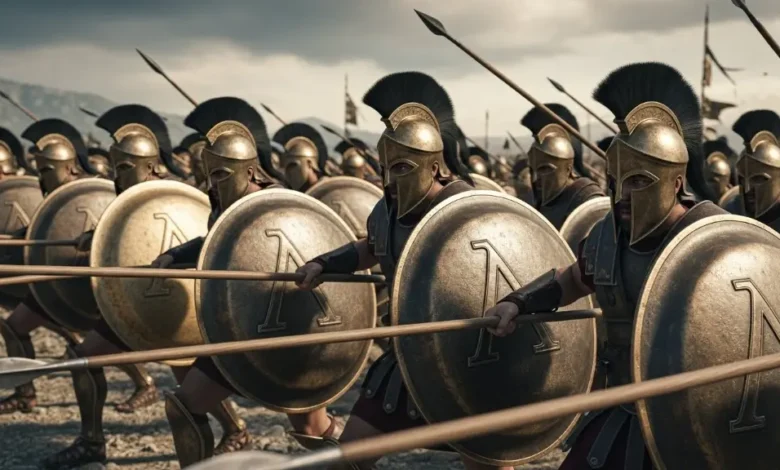
Spartan Hoplites were heavy infantry, optimized for close combat and formation warfare.
Their equipment was designed to function only within disciplined ranks.
Standard Hoplite Equipment
- Hoplon (Aspis) shield – large round shield protecting adjacent soldiers
- Dory spear – primary thrusting weapon
- Xiphos sword – secondary close-combat weapon
- Bronze helmet, cuirass, greaves
- Distinctive red cloak symbolizing Spartan identity
The Phalanx Formation
The phalanx formation was the core of Spartan battlefield dominance.
Each hoplite overlapped his shield with the next, forming a near-impenetrable wall.
Victory depended on:
- Maintaining formation under pressure
- Advancing in unison
- Never breaking ranks, even under heavy casualties
This doctrine influenced later formations such as the
Macedonian Phalanx, although Sparta prioritized discipline over flexibility.
Spartan Hoplites in Major Battles
Battle of Thermopylae (480 BCE)
The Battle of Thermopylae remains the most iconic example of Spartan Hoplite warfare.
Facing overwhelming Persian forces, the Spartans demonstrated extreme discipline,
terrain exploitation, and psychological impact far beyond their numbers.
Battle of Plataea (479 BCE)
At Plataea, Spartan Hoplites played a decisive role in defeating Persian armies,
proving that disciplined heavy infantry could overcome numerically superior forces
in open battle.
Strengths and Limitations
Strengths
- Unmatched discipline and morale
- Superior formation combat effectiveness
- Lifelong professional military training
Limitations
- Limited tactical flexibility
- Weak adaptability outside phalanx warfare
- Demographic decline caused by rigid citizenship rules
Legacy and Influence on Military History
The Spartan Hoplites established enduring principles of warfare:
discipline over numbers, training as a strategic weapon, and cohesion
as a force multiplier.
Their system influenced later elite formations and remains a cornerstone
in the study of early elite military units.
Related historical context:
Early Elite Military Units
Spartan Hoplites in Modern Military Thought
Modern elite units reference Sparta symbolically rather than tactically,
drawing inspiration from its emphasis on selection rigor, mental resilience,
and collective identity.
Sparta’s true legacy lies not in its weapons, but in its
systematic approach to creating elite warriors.