Persian Immortals (Achaemenid Elite Guard)
The Persian Immortals were the most famous elite military unit of the Achaemenid Empire, serving as the permanent core of Persian imperial power between the 6th and 4th centuries BCE. Unlike most ancient armies that relied on temporary levies, the Immortals were a standing professional force that symbolized stability, continuity, and royal authority.
Origins and Purpose of the Immortals
The Immortals were established under the reign of Cyrus the Great and reached their peak during the rule of Darius I and Xerxes I. Their name derived from a simple but powerful concept: the unit always maintained a fixed strength of exactly 10,000 soldiers. Any casualty was immediately replaced, giving the appearance of an “immortal” force that never diminished.
They functioned simultaneously as:
- Elite heavy infantry
- Royal bodyguards
- Shock troops during major campaigns
- A political symbol of imperial permanence
Organization and Recruitment
The Immortals were recruited primarily from Persian, Median, and Elamite nobility, ensuring absolute loyalty to the king. Service in the Immortals was not only a military role but a prestigious social status within the empire.
Their hierarchical structure allowed for rapid command execution and strict discipline, a rarity among ancient Near Eastern armies.
Weapons, Armor, and Equipment
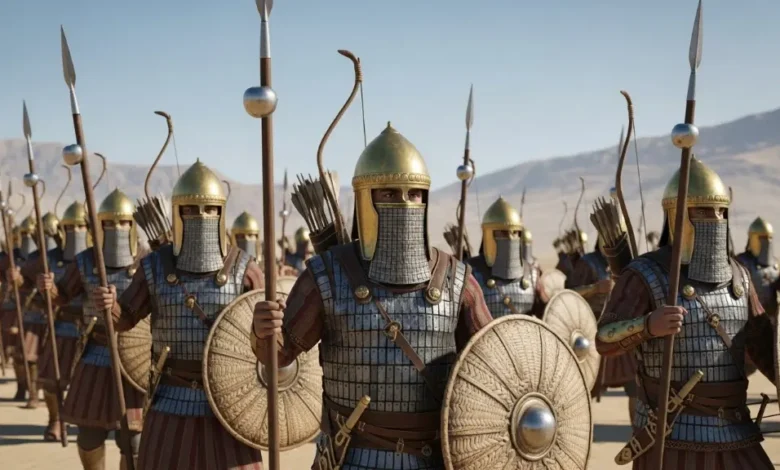
Although often misrepresented as lightly armed, the Immortals were well-equipped for both battlefield combat and defensive operations.
- Long spears for formation fighting
- Composite bows for ranged engagement
- Short swords or daggers for close combat
- Wicker shields reinforced with leather
- Scale armor or padded tunics
Gold and silver ornamentation distinguished officers, reinforcing both morale and psychological dominance over enemies.
Tactical Role on the Battlefield
The Immortals operated as disciplined heavy infantry capable of holding ground, supporting cavalry, and delivering decisive pressure at critical points of battle. Their flexibility allowed Persian commanders to deploy them defensively or offensively depending on strategic needs.
Unlike Greek hoplites, the Immortals relied on combined-arms coordination rather than brute formation strength, integrating archery with spear combat.
Major Campaigns and Historical Impact
The Immortals participated in nearly every major Achaemenid campaign, including the Persian expansion into Mesopotamia, Anatolia, and the Levant. They played a central role during the Greco-Persian Wars, appearing at battles such as Thermopylae and Plataea.
At Thermopylae, the Immortals were personally deployed by Xerxes to break Spartan resistance, highlighting their status as the empire’s ultimate battlefield solution.
Strengths and Limitations
Strengths
- Permanent professional structure
- High discipline and loyalty
- Symbolic psychological impact
- Effective combined-arms capability
Limitations
- Less effective in dense melee against heavy hoplite formations
- Dependent on broader army coordination
- Vulnerable in rough terrain without support
Legacy of the Persian Immortals
The Persian Immortals represent one of the earliest examples of a permanent elite military guard tied directly to state power. Their structure influenced later imperial guard units across Eurasia, including Roman and Byzantine formations.
Within the broader evolution of elite warfare, the Immortals stand as a bridge between ancient warrior aristocracies and fully professional standing armies, comparable to highly mobile elite systems such as the Mongol Tumen, which later redefined warfare through speed, organization, and strategic flexibility.