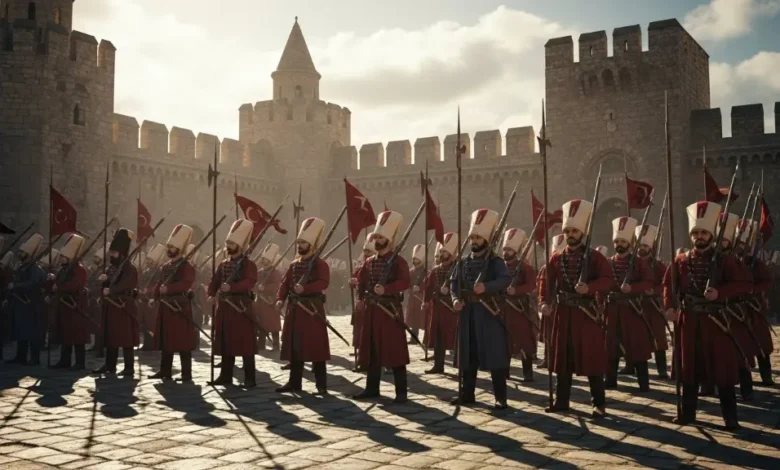
Ottoman Janissaries – The First Modern Professional Infantry
The Janissaries were an elite infantry corps of the Ottoman Empire, forming the backbone of the Sultan’s army. Established in the 14th century, they were highly disciplined, politically influential, and instrumental in Ottoman military expansion.
Origins and Formation
The Janissary corps was founded by Sultan Murad I in the late 1300s. Recruited primarily through the devshirme system, Christian boys from the Balkans were converted to Islam and trained as soldiers loyal solely to the Sultan.
- Established around 1383–1385 as the Sultan’s household troops
- Recruited through the devshirme system from conquered territories
- Received rigorous military and religious training
- Bound by absolute loyalty to the Sultan, not their families
Military Role and Campaigns
Janissaries became pioneers of early modern infantry, integrating firearms and disciplined formations long before European armies adapted similar tactics.
- Elite infantry equipped with muskets, rifles, and polearms
- Played decisive roles in the Battle of Kosovo (1389) and the Siege of Constantinople (1453)
- Known for cohesion, discipline, and battlefield effectiveness
- Participated in both offensive campaigns and elite palace security
Organization and Structure
The Janissary corps maintained a strict hierarchy and internal culture that combined military professionalism with social identity.
- Agha of the Janissaries – commander of the corps
- Orta units – battalion-level formations
- Specialist roles: artillery operators, musicians, and clerks
- Unique cultural elements: uniforms, marching music, and rituals
Legacy and Historical Impact
The Janissaries influenced military organization and elite unit formation across Europe and Asia. Their rise demonstrated the effectiveness of professional standing infantry in an era dominated by cavalry.
- One of the first consistently trained infantry units in world history
- Inspired later Ottoman military reforms and European infantry tactics
- Political influence often exceeded their military role, shaping Ottoman governance
- Disbanded in 1826 by Sultan Mahmud II during the “Auspicious Incident” to modernize the army