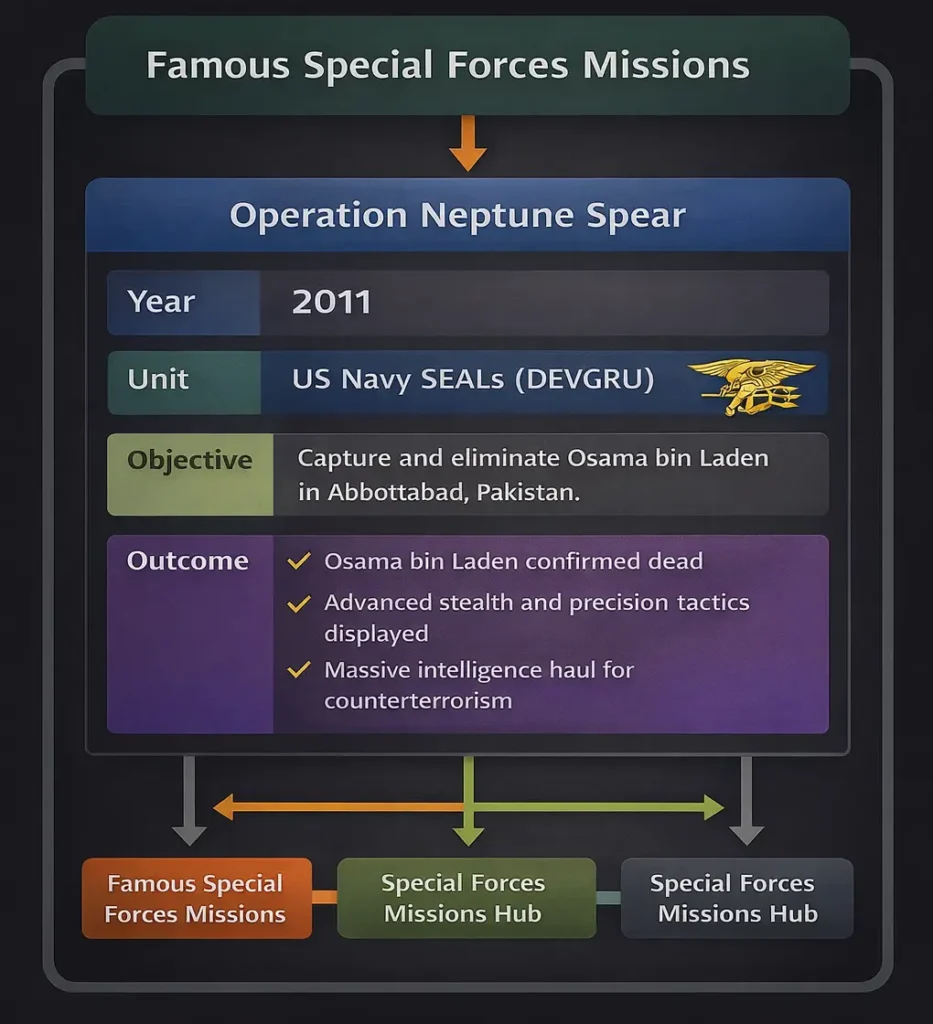
Operation Neptune Spear was a covert mission carried out on May 2, 2011, by the US Navy SEALs (DEVGRU) to eliminate Osama bin Laden in Abbottabad, Pakistan. This mission is one of the most widely recognized special forces operations in contemporary history, illustrating the integration of intelligence, precision, and technology.
Mission Background
Osama bin Laden, the mastermind of the September 11 attacks, had been hiding in a fortified compound. CIA intelligence pinpointed his location, enabling a targeted strike without provoking wider conflict.
Planning and Strategy
- Reconnaissance: Satellite imagery, human intelligence, and surveillance of compound movements.
- Stealth approach: Helicopters with low radar profiles to infiltrate the compound undetected.
- Mission rehearsal: Full-scale replica training for SEAL teams to simulate the operation.
Execution
The SEAL team infiltrated the compound at night, neutralizing threats and confirming bin Laden’s identity. Key elements included:
- Rapid breach and room clearance.
- Intelligence collection on materials inside the compound.
- Extraction under hostile conditions with zero friendly casualties.
Outcome and Impact
Osama bin Laden was killed, ending a decade-long manhunt. The mission demonstrated:
- The power of joint intelligence and operational coordination.
- Advanced special forces training and tactics for counterterrorism.
- Global strategic messaging and deterrence impact.
Legacy
Operation Neptune Spear is a benchmark in counterterrorism missions, influencing modern Navy SEAL doctrine and direct action operations worldwide.