The Evolution of the “Quiet Professional”: A History of Special Forces
In the darkest days of 1940, with continental Europe crushed under the boot of the Axis powers, British Prime Minister Winston Churchill demanded a new kind of warfare. He called for the creation of “specially trained troops of the hunter class, who can develop a reign of terror down the enemy coast.” He ordered his staff to set Europe ablaze. From this desperate, defiant order, the modern concept of Special Operations Forces (SOF) was born.
The journey from those scrappy, swashbuckling commandos of World War II to the high-tech, multi-skilled “Quiet Professionals” of today is a remarkable story of evolution. It’s a history forged in the crucible of conflict, shaped by technological leaps, and driven by the timeless need for a small group of exceptional individuals to achieve strategic results where conventional armies cannot.
This article will trace that evolution. We will go back to the birth of these “shadow warriors,” follow them through the clandestine operations of the Cold War, witness their dramatic rise in the age of terrorism, and understand what they are becoming in the complex new era of global power competition.
📜 The Genesis: World War II, The Great Catalyst
Before WWII, the concept of a permanent, professional special forces unit did not truly exist. The war changed everything, creating a desperate need for unconventional solutions. Several key organizations emerged, forming the DNA of all future SOF.
🇬🇧 The British Commandos & SAS: “Butcher and Bolt”
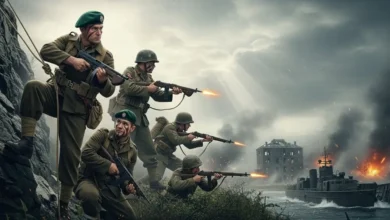
- The Commandos: These were the direct answer to Churchill’s call. Formed from volunteers across the British Army, they were trained for amphibious raiding—to “butcher and bolt.” They would hit enemy coastal installations, gather intelligence, cause chaos, and disappear back into the sea. They were the blunt instrument of unconventional attack.
- The Special Air Service (SAS): Lieutenant David Stirling, a young Commando officer, had a more radical idea. He believed a small, highly independent team operating deep behind enemy lines could do far more strategic damage than a large coastal raid. His “L Detachment” SAS, driving armed jeeps across the North African desert, destroyed hundreds of enemy aircraft on the ground, strangling Rommel’s supply lines. Stirling’s genius was the concept of the small, autonomous team achieving strategic effects.
🇺🇸 The American OSS & Rangers: Intelligence and Raiding
- The Office of Strategic Services (OSS): This was America’s answer to British intelligence and special operations. Led by the legendary William “Wild Bill” Donovan, the OSS was tasked with intelligence gathering, espionage, and, crucially, Unconventional Warfare (UW). Its “Jedburgh” teams parachuted into occupied France to arm, train, and lead the French Resistance, a mission that would become the cornerstone of the future U.S. Army Special Forces.
- The U.S. Army Rangers: Modeled on the British Commandos, the Rangers were elite light infantry trained for direct action. Their famous motto, “Rangers lead the way,” was born on the bloody sands of Omaha Beach. They specialized in high-risk missions like scaling the cliffs of Pointe du Hoc on D-Day.
The WWII Legacy: These units were largely disbanded after the war. But they had proven a vital concept: small teams of specially selected and trained soldiers could have an impact far outweighing their numbers. The seeds were planted.
❄️ The Cold War: A Clandestine Chess Match
The end of WWII gave way to a new kind of global conflict: the Cold War. This was a struggle fought not in massive trench lines, but in the shadows, through proxy wars, and in the “grey zone” between peace and total war. This environment was the perfect incubator for the formal rebirth of special forces.
The Green Berets and Unconventional Warfare
In 1952, drawing on the legacy of the OSS, the U.S. Army formed the 10th Special Forces Group. Led by Colonel Aaron Bank, an OSS veteran, their mission was explicit: to infiltrate behind Soviet lines in the event of a European war and organize resistance movements—a direct continuation of the Jedburgh mission.
This was the birth of the modern U.S. Army Special Forces (the Green Berets). Their focus was not just on fighting, but on teaching, advising, and multiplying their force by working with and through others. This unique “Unconventional Warfare” mission set them apart. During the Vietnam War, they put this doctrine into practice, living and fighting alongside Montagnard tribesmen in the remote highlands.
The Rise of Counter-Terrorism
The 1970s saw the terrifying rise of international terrorism. The 1972 Munich Olympics massacre, where Israeli athletes were murdered, was a global wake-up call. Conventional armies were ill-equipped to handle hostage situations in crowded urban environments.
A new, even more specialized type of SOF was needed.
- GSG 9 (Germany): Formed directly in response to the Munich tragedy, Germany’s GSG 9 became a world-class police counter-terrorist unit.
- GIGN (France): France’s elite GIGN was formed for the same reason, becoming masters of surgical hostage rescue.
- Delta Force (USA) & SAS (UK): The military also adapted. The US Army created its secretive Delta Force, and the UK’s SAS developed its own elite counter-terrorist “wing.” The SAS’s successful 1980 Iranian Embassy siege, broadcast live on television, dramatically brought this new capability out of the shadows and into the public imagination.
💥 The Post-9/11 Era: The “Global War on Terror”
The attacks of September 11, 2001, caused the most significant evolution in special operations since WWII. The “Global War on Terror” was a conflict without borders, fought against a shadowy, non-state enemy. This was a war tailor-made for SOF.
The “Golden Age” of SOF
Over the next two decades, SOF units, particularly under the U.S. Joint Special Operations Command (JSOC), became the primary tool of U.S. foreign policy.
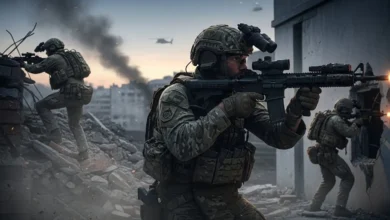
- The Man-Hunters: The focus shifted heavily to Direct Action (DA) and Special Reconnaissance (SR). SOF teams became relentless “man-hunters,” tasked with finding, fixing, and finishing high-value targets. This era was defined by night raids, drone strikes, and intelligence-driven operations.
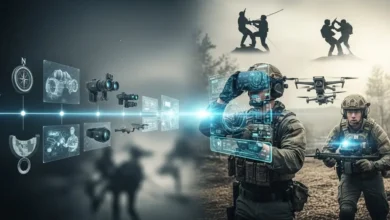
- Technological Leaps: This period saw an explosion in technology. Night vision, advanced communications, GPS, biometric scanners, and stealth helicopters became standard issue. The modern SOF operator became a walking network of advanced technology.
- The Rise of the “Operator”: The public image shifted from the “Rambo” stereotype to the quiet, bearded, and highly skilled “Operator.” The raid that killed Osama bin Laden in 2011, conducted by the Navy’s elite SEAL Team Six (DEVGRU), was the pinnacle of this era—a globally televised example of a surgical, intelligence-driven SOF mission.
While incredibly effective, this intense focus on direct action led to concerns that some units, particularly the Green Berets, were drifting away from their core mission of Unconventional Warfare.
🔮 The Future: Great Power Competition and the Hybrid Warrior
Today, the world is shifting again. The focus on counter-terrorism is being balanced by a renewed era of “Great Power Competition” with near-peer adversaries like Russia and China. This new environment demands another evolution from SOF.
The Return of the “Grey Zone”
Future conflicts are less likely to be massive invasions and more likely to be fought in the “grey zone”—through cyber warfare, disinformation campaigns, political subversion, and the use of proxy forces. This is the natural habitat of the special operator.
The Hybrid Operator
The SOF soldier of the future must be a hybrid:
- Warrior: Still capable of lethal direct action when required.
- Diplomat: Able to build relationships and work with allies in complex political environments.
- Spy: Proficient in intelligence gathering, surveillance, and understanding the information landscape.
- Tech Expert: Comfortable operating in the digital world, understanding cyber threats, and leveraging technology to their advantage.
The U.S. Army’s new “Advisor Brigades” (SFABs) are one example of this shift, taking the Green Berets’ traditional training mission and applying it on a larger scale. The future of SOF is about returning to the roots of the OSS and the SAS—small teams, operating with strategic vision, using their minds as their primary weapon.
Conclusion: The Timeless Constant
From the swashbuckling Commandos raiding the coasts of Norway to the high-tech DEVGRU operators in Abbottabad, the tools and the missions of special forces have evolved dramatically. The canvas of conflict has changed from industrial warfare to clandestine proxy wars to a global hunt for terrorists, and now to a digital and political chess match.
But the core DNA, the timeless constant, remains the same. The success of special operations has never truly been about the technology or the weapons. It has always been about the individual. It is about selecting the rare person who combines intelligence, physical endurance, and an unbreakable character, and then trusting them to achieve the impossible when all other options have failed. The spirit of the hunter class that Churchill called for in 1940 is alive and well, quietly adapting to the challenges of a new century, forever at the tip of the spear.
❓ Frequently Asked Questions about the Evolution of SOF
Q1: What was the single most important development in the history of special forces?
A: While many would point to specific operations or technologies, a strong argument can be made that the most important development was the formalization of the selection process. Early units were made of enthusiastic volunteers. Modern SOF realized that the key to success was not finding brave men, but creating a system to identify men with the specific psychological attributes to succeed under extreme stress—resilience, intelligence, and teamwork. The selection course is the heart of every elite unit.
Q2: Did all special forces units originate from WWII?
A: No, but the vast majority of modern Western units trace their lineage or doctrine back to the British Commandos, SAS, or the American OSS. These organizations created the “playbook” for unconventional warfare, direct action, and special reconnaissance that most others have adapted. Units formed later, like Germany’s GSG 9, were created in response to different threats (terrorism) but still studied the principles established by the WWII pioneers.
Q3: How has the public perception of special forces changed?
A: Dramatically. For decades, they were almost completely secret, their existence barely acknowledged. The Vietnam War brought the Green Berets into the public eye, often in a romanticized way. The 1980 Iranian Embassy siege made the SAS world-famous. The post-9/11 era, with its books, movies, and video games, has put the “operator” image into hyperdrive. This has been a double-edged sword, bringing greater support and funding but also eroding the traditional “quiet professional” ethos.
Q4: Is the “Rambo” stereotype accurate at all?
A: No. The “Rambo” stereotype of a lone-wolf muscle-bound super soldier is the exact opposite of a real special operator. Real SOF operates in teams, relies on intelligence and careful planning, and values brain over brawn. A special operator’s most important weapon is their mind and their ability to work with their teammates.