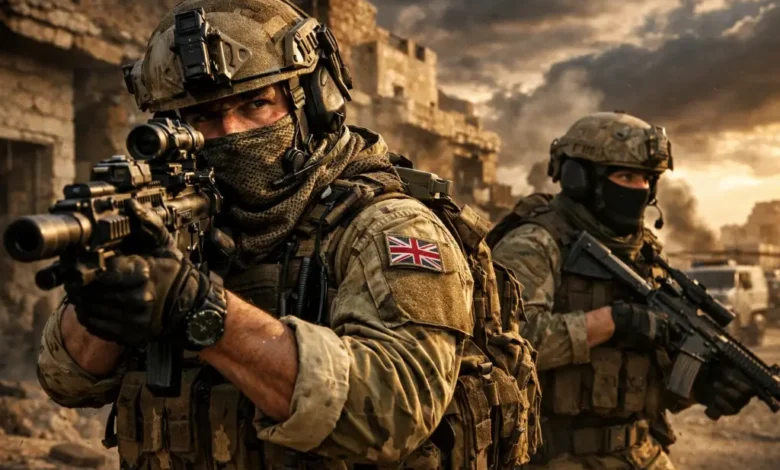
British SAS – Founders of Modern Special Forces
Origins of the Special Air Service
The British Special Air Service (SAS) was founded in 1941 during the darkest period of the Second World War, when conventional military doctrine proved insufficient against Axis forces in North Africa. Created by David Stirling, the SAS introduced a radically new concept: small, highly trained units conducting deep-penetration raids behind enemy lines. This approach would permanently redefine modern special operations warfare.
Revolutionary Doctrine and Asymmetric Warfare
Unlike traditional infantry or commando units, the SAS operated with extreme autonomy, flexibility, and speed. Their missions focused on strategic disruption rather than territorial control, targeting enemy airfields, supply depots, and communication networks. This doctrine emphasized initiative at the lowest level, a principle that later became foundational to special forces worldwide.
- Small-unit independent operations
- Deep reconnaissance and sabotage missions
- Extreme emphasis on adaptability and improvisation
- Minimal logistical footprint
World War II Operations and Impact
During the North African campaign, SAS teams used modified jeeps to strike deep into Axis-controlled territory, destroying hundreds of enemy aircraft on the ground. These operations demonstrated that elite units could achieve strategic-level effects disproportionate to their size, forcing enemy forces to divert resources to rear-area security.
Later operations in Italy, France, and occupied Europe further validated the SAS model, integrating airborne insertion, resistance coordination, and long-range patrols into a coherent operational system.
Post-War Evolution and Global Influence
After World War II, the SAS was briefly disbanded, only to be reactivated as Cold War conflicts highlighted the need for elite unconventional forces. Counterinsurgency operations in Malaya refined SAS jungle warfare tactics, influencing doctrines later adopted by allied nations. These experiences directly shaped the formation of modern units such as the US Navy SEALs, Delta Force, and other NATO special operations forces.
Counter-Terrorism and Modern Operations
The SAS became globally recognized in the late 20th century for its counter-terrorism role, particularly after the 1980 Iranian Embassy siege in London. This operation showcased precision assault techniques, hostage rescue doctrine, and intelligence-driven planning that set international standards for counter-terror units.
- Hostage rescue and urban assault
- Covert reconnaissance and intelligence gathering
- Counterinsurgency and foreign internal defense
- Strategic direct-action missions
Selection, Training, and Warrior Culture
SAS selection is considered one of the most demanding military selection processes in the world. It prioritizes mental resilience, self-discipline, and independent decision-making over raw physical strength. This culture produces operators capable of functioning in isolation under extreme stress, a defining trait of elite special forces.
Legacy in Elite Military History
The British SAS is widely regarded as the blueprint for modern special forces. Its emphasis on adaptability, decentralized command, and strategic impact continues to shape elite military units across the globe. Within the broader framework of elite military evolution, the SAS represents the transition from massed conventional warfare to precision-based special operations.
In the context of modern elite units, the SAS stands alongside formations such as Sayeret Matkal, sharing a common philosophy of intelligence-driven, high-impact operations.