JSOC Units Explained: A Deep Dive into Delta Force, DEVGRU, and America’s Shadow Warriors
In the modern landscape of warfare, there exists a command that lives in the shadows, a “ghost command” spoken of in hushed tones and tasked with America’s most sensitive and dangerous missions. This entity is the Joint Special Operations Command, or JSOC. It is not a unit but a command structure, the master puppeteer coordinating the nation’s most elite “Tier 1” special operations forces.
This article will pull back the curtain on this secretive organization, tracing its fiery birth from the ashes of a catastrophic failure, detailing the elite units under its command, and exploring its transformation from a reactive counter-terrorism force into a global, man-hunting machine. This is the story of JSOC, the quiet professionals’ command, an organization forged in failure and perfected in the crucible of modern warfare.
Forged in Fire: The Failure of Operation Eagle Claw
To understand why JSOC exists, you must first understand the disaster of April 24, 1980. On that day, America’s top special operators launched Operation Eagle Claw, a complex mission to rescue 52 American hostages held in Tehran, Iran. The plan involved units from the Army, Navy, Air Force, and Marine Corps, but they had rarely, if ever, trained together.
The result was a catastrophe. In the Iranian desert, a sandstorm, helicopter maintenance failures, and a tragic ground collision between a C-130 and a helicopter left eight service members dead. The mission was aborted, a national humiliation. The subsequent investigation, known as the Holloway Report, identified a primary cause: a complete lack of a unified command structure and interoperability between the different service branches. As the report grimly concluded, the forces were not trained to “operate as a joint team” (Holloway, et al., Rescue Mission Report, 1980).
From this failure, two things were born: a resolve that it would never happen again, and a new command to ensure it. In late 1980, the Joint Special Operations Command was officially activated at Fort Bragg, North Carolina. Its founding mission was simple but critical: to create a standing, unified command that could study, standardize, and execute special operations with lethal, joint precision.
What is JSOC? The Command, Not the Unit
A common misconception is that JSOC is itself a fighting unit like Delta Force. This is incorrect. JSOC is a “command of commands,” a sub-unified command under the larger U.S. Special Operations Command (SOCOM). Its primary role is to act as the headquarters for the nation’s premier Special Mission Units (SMUs), often referred to as “Tier 1” assets.
JSOC’s responsibilities include:
- Standardizing training and equipment: Ensuring that the elite units from different branches can operate seamlessly together.
- Conducting joint special operations exercises: Forging interoperability through constant, realistic training.
- Operational Control: Taking direct command of SMUs for specific, high-stakes missions designated by the President or the Secretary of Defense.
In short, when a mission requires the absolute best operators from the Army, Navy, and Air Force to work together, JSOC is the organization that runs the show.
The Tier 1 Arsenal: The Special Mission Units of JSOC
JSOC’s power comes from the lethal and highly specialized units under its direct command. While the full list is classified, its primary components are well-known within the defense community.
| Unit Name | Service Branch | Primary Role |
|---|---|---|
| 1st SFOD-D (Delta Force) | Army | Counter-Terrorism, Hostage Rescue, Direct Action |
| DEVGRU (SEAL Team Six) | Navy | Maritime Counter-Terrorism, Direct Action |
| 24th Special Tactics Squadron | Air Force | Airfield Seizure, Personnel Recovery, Air Support |
| Intelligence Support Activity | Joint | Signals Intelligence (SIGINT), Human Intelligence (HUMINT) |
1st Special Forces Operational Detachment-Delta (Delta Force)
Often referred to as “CAG” (Combat Applications Group) or simply “The Unit,” Delta Force is the Army’s premier SMU. Founded by Colonel Charles Beckwith, who served with the British SAS, Delta Force specializes in direct action and counter-terrorism, particularly in non-permissive environments. Its operators are selected primarily from the Army’s Special Forces and Ranger Regiment and must pass a notoriously difficult selection course that tests their physical endurance and psychological resilience to the breaking point.
Naval Special Warfare Development Group (DEVGRU)
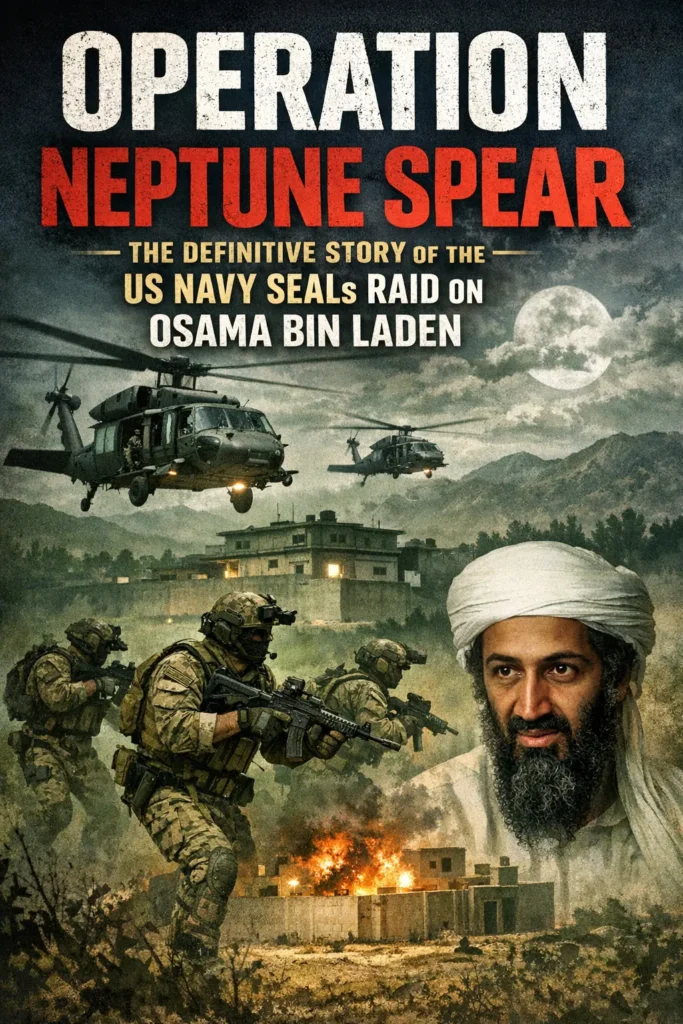
Colloquially known as SEAL Team Six, DEVGRU is the Navy’s counterpart to Delta Force. It recruits exclusively from the existing pool of experienced Navy SEALs.
While it performs many of the same missions as Delta, DEVGRU maintains a particular expertise in maritime operations, such as ship boardings and offshore platform assaults. It was the unit responsible for conducting Operation Neptune Spear, the raid that killed Osama bin Laden, cementing its place in the public consciousness.
For a detailed breakdown of this historic mission, read our article Operation Neptune Spear: The Definitive Story of the US Navy SEALs Raid.
The 24th Special Tactics Squadron (24th STS)
The 24th STS is the often-unsung hero of JSOC. Comprised of Air Force Combat Controllers (CCTs) and Pararescuemen (PJs), this unit provides the critical link between the air and the ground. Its operators are tasked with infiltrating hostile territory ahead of the main assault force to seize airfields, call in precision airstrikes, and provide life-saving medical treatment. As one JSOC operator noted, “Delta or DEVGRU might kick down the door, but the 24th are the guys who got us to the door and own the sky above it.”
The Intelligence Support Activity (ISA)
Known by many codenames over the years (“The Activity”), the ISA is JSOC’s secret weapon for intelligence. It is a deep-cover intelligence collection unit, tasked with providing real-time, actionable intelligence to the assault teams. Its operatives are masters of signals intelligence (intercepting communications) and human intelligence (running agents), providing the “unblinking eye” that finds the target long before the shooting starts.
From Reactive Force to Global Hunter: The Post-9/11 Transformation
For the first two decades of its existence, the role of JSOC was primarily reactive—a “break glass in case of emergency” force for hostage crises. The attacks of September 11, 2001, changed everything.
In the wars in Afghanistan and Iraq, JSOC was unleashed. Under the leadership of then-General Stanley McChrystal, JSOC transformed from a specialized tool into a relentless, global man-hunting machine. As documented by journalist Sean Naylor in his seminal book Relentless Strike (2015), McChrystal revolutionized the command.
The McChrystal Revolution: “It Takes a Network to Defeat a Network”
McChrystal recognized that defeating a decentralized network like al-Qaeda required JSOC to become a network itself. He implemented several key changes:
- F3EA Targeting Cycle: He perfected the “Find, Fix, Finish, Exploit, Analyze” model. A raid wasn’t over when the target was killed or captured (“Finish”). The most crucial phase was “Exploit,” where intelligence gathered on-site (laptops, phones) was immediately analyzed (“Analyze”) to generate the next target (“Find”), often leading to another raid the very same night.
- Daily Video Conferences: McChrystal flattened the command structure, holding daily video teleconferences that connected everyone from the CIA analyst in Virginia to the Delta operator in Iraq. This broke down information silos and enabled a stunningly rapid operational tempo.
- Empowering the Edges: He pushed decision-making authority down to the lowest possible levels, allowing assault teams on the ground to act immediately on new intelligence without waiting for approval from headquarters.
This transformation turned JSOC into a learning organization that could adapt faster than its enemy. It was this model that systematically dismantled the al-Qaeda in Iraq network and eventually led to the doorstep of Osama bin Laden.
JSOC in Action: Defining Moments
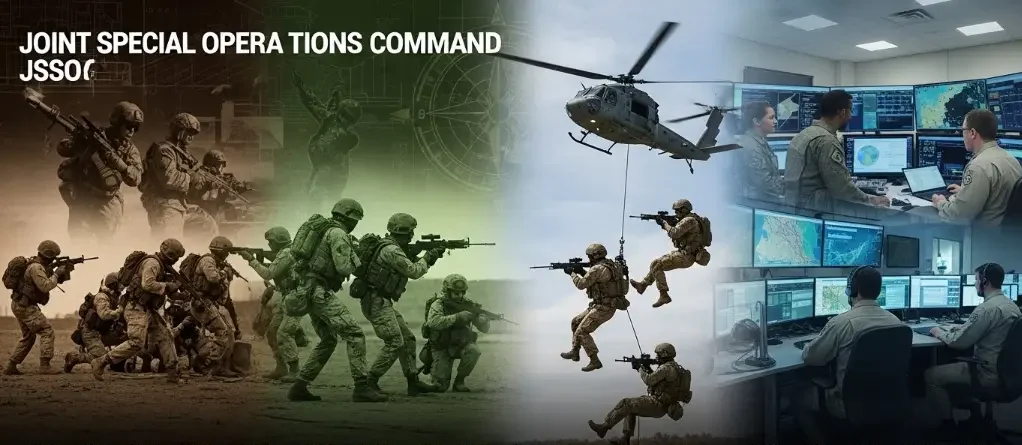
JSOC’s history is written in the blood and fire of America’s most critical conflicts.
- Operation Urgent Fury (1983) & Operation Just Cause (1989): In Grenada and Panama, JSOC units conducted hostage rescues and captured key enemy figures, demonstrating their growing capabilities but also revealing continued “joint” friction.
- Operation Gothic Serpent (1993): The “Black Hawk Down” incident in Mogadishu, Somalia, was a defining moment. Delta Force and Rangers were tasked with capturing a Somali warlord. The mission was a tactical success—the targets were captured—but it devolved into a brutal 18-hour firefight that resulted in 18 American deaths. As Mark Bowden documented in Black Hawk Down (1999), the battle highlighted JSOC’s incredible courage and skill but also the risks of operating without overwhelming force.
- The Global War on Terror (2001-Present): Post-9/11, JSOC became the primary tool for hunting High-Value Targets (HVTs) across Iraq, Afghanistan, and other “undeclared battlefields” in Yemen, Somalia, and North Africa.
- Operation Neptune Spear (2011): This was the pinnacle of the modern JSOC. The raid to kill Osama bin Laden was a perfectly synchronized joint operation involving DEVGRU, the 24th STS, and the ISA, showcasing the full maturity of the command forged 30 years prior.
An Enduring and Evolving Legacy
From the smoldering wreckage in the Iranian desert, the Joint Special Operations Command rose to become the most lethal and effective special operations force in history. It is a testament to the American military’s ability to learn from catastrophic failure and adapt. The history of JSOC is a story of constant evolution—from a small, specialized command into a global, networked enterprise that fuses intelligence and operations with unprecedented speed and precision.
While its missions remain shrouded in secrecy, the role of JSOC is clear: to be the nation’s ultimate problem-solver for the threats that live in the dark. It is the embodiment of the “Quiet Professional” ethos, a command that does not seek credit but relentlessly pursues its objective. In an era of persistent, shadowy conflict, the need for a command like JSOC—ready, adaptable, and lethal—is more critical than ever.
What part of JSOC’s history do you find most compelling? The difficult lessons learned or the incredible capabilities it developed? Share your thoughts in the comments below, subscribe for more content on military history, and share this article.
Frequently Asked Questions (FAQs)
Q1: What is the difference between JSOC and SOCOM?
A: U.S. Special Operations Command (SOCOM) is the parent command for all U.S. special operations forces, including the Green Berets, Navy SEALs, Army Rangers, and MARSOC. JSOC is a sub-command within SOCOM, responsible only for the most elite, “Tier 1” Special Mission Units and their specific missions. Think of SOCOM as the entire university, and JSOC as its highly specialized Ph.D. program.
Q2: Is JSOC a secret?
A: The existence of JSOC is not a secret; it is an acknowledged command within the U.S. military. However, its specific operations, funding, capabilities, and the identities of its personnel are highly classified.
Q3: Can women serve in JSOC units?
A: Yes. For many years, women have served in critical support and intelligence roles within JSOC, including with the ISA. Following the opening of all military combat roles to women, they can now theoretically attempt the selection courses for combat units like Delta Force and DEVGRU, though these standards remain incredibly difficult for any candidate to meet.
Q4: How many people are part of JSOC?
A: There is no official public figure. The total number, including operators, intelligence analysts, and support personnel, is estimated to be in the low thousands. The operational “tip of the spear” is much smaller, comprising a few hundred assaulters in the primary SMUs.
References
- Bowden, M. (1999). Black Hawk Down: A Story of Modern War. Atlantic Monthly Press.
- Holloway, J. L., et al. (1980). Rescue Mission Report. U.S. Department of Defense.
- Naylor, S. (2015). Relentless Strike: The Secret History of Joint Special Operations Command. St. Martin’s Press.
- Schmidle, N. (2011, August 8). Getting Bin Laden. The New Yorker. Retrieved from [newyorker.com].