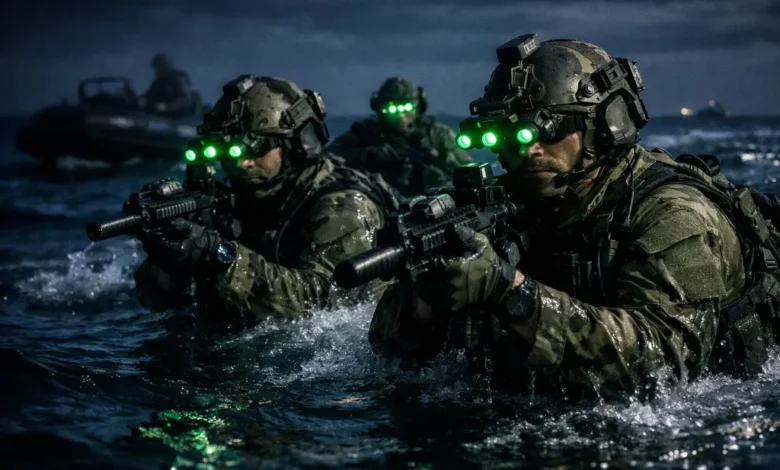
US Navy SEALs – America’s Maritime Special Operations Force
The United States Navy SEALs represent one of the most influential and operationally versatile special operations forces in modern military history. Designed to operate across sea, air, and land, the SEALs embody the evolution of special warfare into a fully integrated global strike and reconnaissance capability.
Origins and Strategic Foundation
The Navy SEALs were officially established in 1962 during the Cold War, drawing lineage from World War II naval special units such as the Underwater Demolition Teams (UDT). Their creation reflected the United States’ need for elite forces capable of unconventional warfare, counterinsurgency, and covert operations in contested environments.
From their inception, the SEALs were shaped by lessons learned alongside allied elite units, including the British SAS and later cooperation with NATO counterparts such as KSK (Germany).
Mission Spectrum and Core Roles
The defining characteristic of the Navy SEALs is operational flexibility. Unlike units focused on a narrow mission set, SEAL teams are trained to execute a wide range of tasks across the full spectrum of conflict.
- Direct action and precision strike missions
- Counterterrorism and high-value target elimination
- Special reconnaissance and intelligence collection
- Unconventional warfare and foreign internal defense
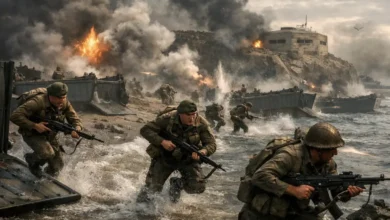
- Maritime interdiction and amphibious operations
Selection and Training Pipeline
SEAL selection is widely regarded as among the most physically and mentally demanding military training pipelines in the world. The process begins with Basic Underwater Demolition/SEAL (BUD/S), where candidates are subjected to extreme physical stress, sleep deprivation, and psychological pressure.
Training prioritizes adaptability, small-unit leadership, and independent decision-making under combat conditions. This philosophy aligns the SEALs with peer units such as GROM (Poland) and Israeli Sayeret Matkal, where operator autonomy is central to mission success.
Operational History and Global Reach
The Navy SEALs have operated in nearly every major US conflict since Vietnam, including Iraq, Afghanistan, and numerous classified theaters worldwide. Their missions often involve deep penetration into hostile territory, requiring precision, secrecy, and coordination with intelligence agencies.
The raid that resulted in the elimination of Osama bin Laden in 2011 cemented the SEALs’ reputation as a strategic-level force capable of executing politically sensitive operations with global impact.
Equipment, Mobility, and Tactical Capabilities
SEAL units employ highly modular equipment configurations tailored to mission requirements, particularly in maritime and littoral environments.
- Specialized assault rifles and suppressed weapons systems
- Combat diving equipment and submersible insertion platforms
- Advanced ISR, drone, and night vision systems
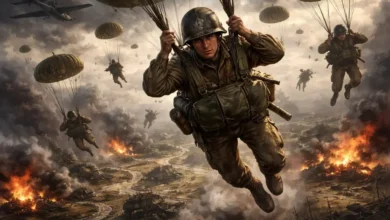
- Airborne and maritime insertion capabilities
Strengths and Operational Constraints
Strengths of the Navy SEALs include unmatched global deployment capability, integration with air and naval assets, and extensive combat experience across diverse operational environments.
Constraints primarily involve operational tempo and force overstretch, a challenge common among elite units with persistent global demand, including the British Commandos during World War II and modern special operations forces.
Legacy and Strategic Influence
The Navy SEALs have profoundly shaped the doctrine, public perception, and operational design of modern special operations forces. Their influence extends beyond combat, impacting training methodologies and joint operations worldwide.
Within the history of elite military units, the US Navy SEALs represent the transition from specialized wartime formations to permanent, globally deployable special operations forces.