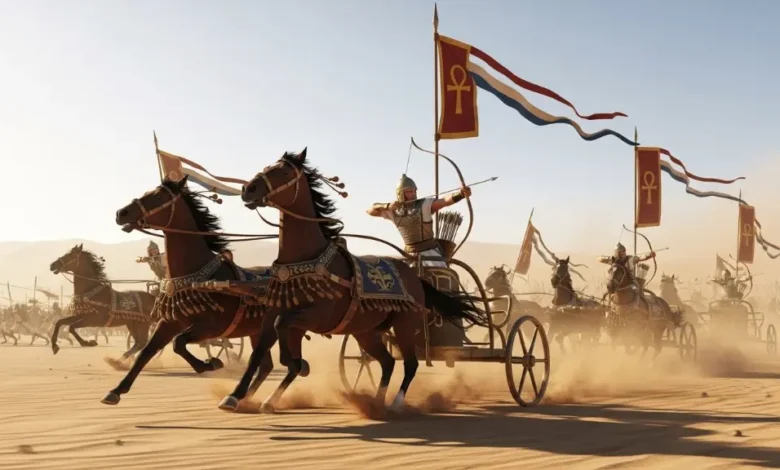
Egyptian Chariot Corps (New Kingdom)
The Egyptian Chariot Corps represented one of the first true mobile shock forces in military history, transforming warfare during Egypt’s New Kingdom period (c. 1550–1070 BCE). By integrating speed, firepower, and command mobility, Egyptian chariots reshaped how ancient armies projected power across open terrain.
Origins of Chariot Warfare in Egypt
Chariots were introduced to Egypt during the Second Intermediate Period, likely through contact with the Hyksos. Rather than merely copying the technology, the Egyptians refined it into a highly effective military system that became central to imperial expansion under pharaohs such as Thutmose III and Ramesses II.
Unlike heavier Near Eastern chariots, Egyptian models emphasized speed, maneuverability, and tactical flexibility.
Structure and Organization
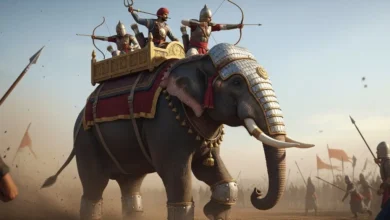
The Egyptian chariot unit typically consisted of a two-man crew: a driver responsible for maneuvering the vehicle and a warrior armed primarily with a composite bow. Chariot units were organized into formations capable of coordinated movement, reconnaissance, and rapid battlefield response.
- Two-man chariot crews (driver + archer)
- Lightweight wooden frames with leather reinforcement
- Horse teams bred for endurance and speed
- Integration with infantry formations
Weapons and Equipment
The primary weapon of the Egyptian chariot warrior was the composite bow, allowing accurate fire while in motion. Secondary weapons included spears, javelins, and sickle-shaped swords (khopesh) for close combat once formations broke.
- Composite bows with high penetration
- Khopesh swords for melee engagements
- Scale or padded armor for elite crews
- Quivers mounted directly on the chariot
Tactical Role on the Battlefield
Egyptian chariots were not designed for direct collision but for dominance through speed and ranged fire. They operated as mobile platforms, disrupting enemy formations, targeting officers, and exploiting weaknesses before infantry advanced.
This doctrine contrasts sharply with later elite infantry-based systems such as the Persian Immortals, highlighting an early divergence between mobility-based warfare and formation-heavy elite units.
Major Campaigns and Battles
The Egyptian Chariot Corps played a decisive role in campaigns across the Levant and Syria. Their most famous engagement occurred at the Battle of Kadesh (c. 1274 BCE), where Ramesses II used chariot maneuverability to stabilize Egyptian forces against the Hittite army.
While the battle ended indecisively, it demonstrated the strategic importance of chariot forces in large-scale imperial warfare.
Strengths and Weaknesses
Strengths
- Exceptional mobility and speed
- Effective ranged combat while moving
- Command and control advantages
- Psychological impact on infantry-based enemies
Weaknesses
- Limited effectiveness in rough or mountainous terrain
- High logistical demands (horses, maintenance)
- Vulnerability if isolated from infantry support
Legacy of the Egyptian Chariot Corps
The Egyptian Chariot Corps established mobility as a decisive factor in warfare centuries before cavalry dominance. Their doctrine influenced later chariot-based armies across the Near East and laid conceptual foundations for fast-moving elite forces throughout military history.