Viking Great Heathen Army
The First Coordinated Viking Invasion and a Turning Point in Medieval Warfare
Origins of the Great Heathen Army
The Viking Great Heathen Army was not a mere raiding force but a large, organized coalition of Scandinavian warriors that invaded Anglo-Saxon England in 865 CE.
Unlike earlier hit-and-run Viking raids, this army pursued territorial conquest and political domination.
Led by legendary figures such as Ivar the Boneless, Halfdan Ragnarsson, and Ubba, the Great Heathen Army marked the transition from Viking piracy to sustained military occupation.
Strategic Innovation: From Raids to Invasion
The defining feature of the Great Heathen Army was its strategic patience. Instead of attacking monasteries and coastal towns, the Vikings captured
key urban centers and forced Anglo-Saxon kingdoms into submission.
- Long-term winter camps (overwintering)
- Combined infantry and mobile raiding units
- Psychological warfare through brutality and symbolism
- Exploitation of political fragmentation in England
Weapons, Equipment, and Combat Style
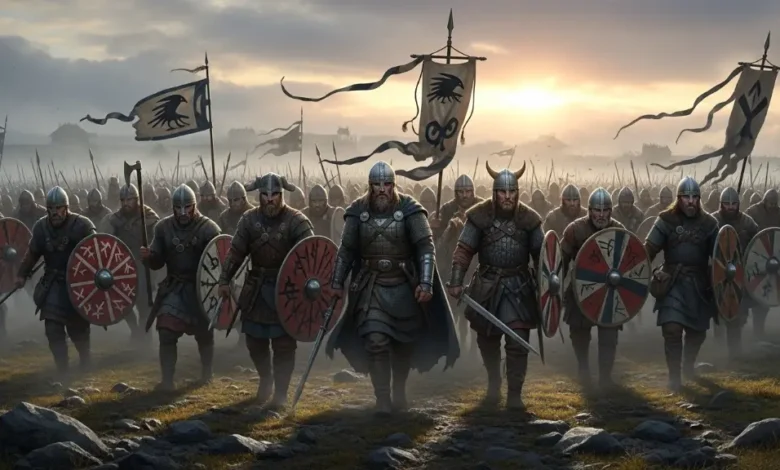
The army consisted of professional warriors equipped for both shock combat and rapid movement across difficult terrain.
Standard Viking Equipment
- Spears and axes (primary weapons)
- Round wooden shields with iron bosses
- Seax knives and swords (elite warriors)
- Mail armor and conical helmets (limited but present)
Combat emphasized aggressive infantry assaults, shield walls, and swift tactical withdrawals when necessary.
Campaigns Across Anglo-Saxon England
Capture of York (866 CE)
The fall of York destroyed the independent kingdom of Northumbria and provided the Vikings with a strategic base for future campaigns.
Wars Against Wessex
The Great Heathen Army clashed repeatedly with King Alfred the Great. While eventually halted, the Vikings forced Wessex into treaties that reshaped England’s political map.
The Danelaw and Political Impact
The aftermath of the invasion resulted in the establishment of the Danelaw, a region governed by Norse law, culture, and military power.
This hybrid system transformed English society for generations.
Strengths and Weaknesses
Strengths
- Operational flexibility and mobility
- Experienced warrior culture
- Psychological dominance over fragmented enemies
Weaknesses
- Lack of centralized command structure
- Dependence on local resources
- Limited siege capabilities
Legacy of the Great Heathen Army
The Viking Great Heathen Army proved that non-state warrior cultures could conduct sustained military campaigns against established kingdoms. Its success influenced later medieval invasion strategies.
Within the broader context of elite military history, it represents one of the earliest examples of coordinated expeditionary warfare.
Connection to Elite Military Evolution
The Great Heathen Army bridges early warrior societies and later professional armies, forming a key chapter in the
history of early elite military units.