
Types of Special Forces Missions
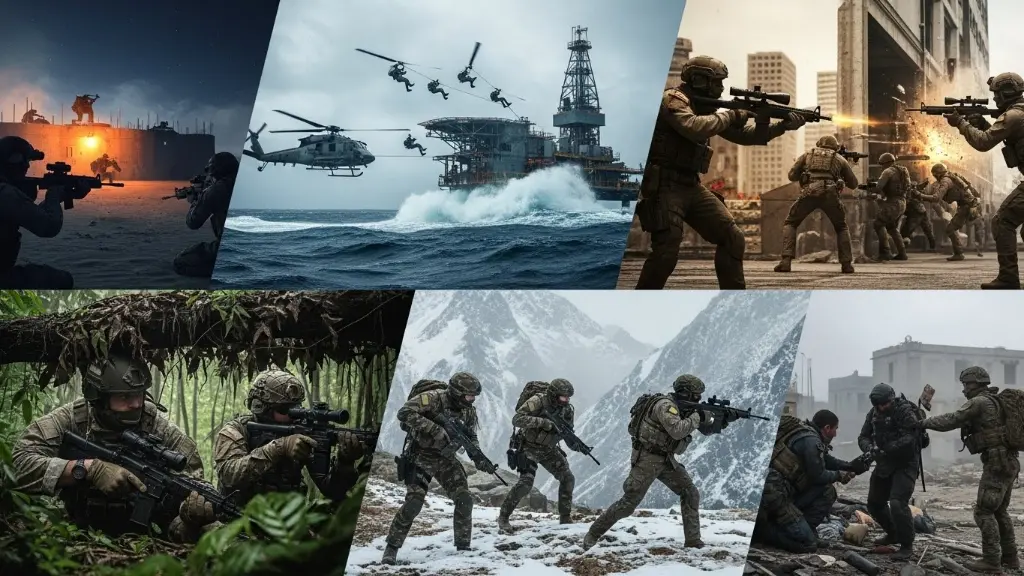
Special Forces missions are designed to achieve strategic objectives that conventional military units cannot easily accomplish. These missions require elite training, advanced intelligence, stealth, and precision execution. Understanding the different types of special operations is essential to fully appreciate how elite units operate across the globe.
This guide breaks down the main types of Special Forces missions, explaining their objectives, methods, and real-world examples from famous special operations.
1. Direct Action Missions
Direct Action (DA) missions involve short-duration strikes and small-scale offensive operations. These missions are designed to seize, destroy, capture, or neutralize enemy targets with speed and surprise.
Key Characteristics
- Short execution time
- High-intensity combat
- Precision targeting
- Rapid extraction
Common Objectives
- High-value target elimination
- Raids on enemy facilities
- Capture of key individuals
Famous Examples
- Operation Neptune Spear – US Navy SEALs
- Operation Gothic Serpent – Delta Force & Rangers
Direct action missions rely heavily on intelligence accuracy and precise coordination between assault teams and supporting assets.
2. Special Reconnaissance Missions
Special Reconnaissance (SR) missions focus on collecting intelligence in hostile or denied areas. These operations often take place deep behind enemy lines and may last days or weeks.
Key Characteristics
- Covert insertion
- Extended duration
- Minimal engagement
- Stealth and concealment
Mission Objectives
- Enemy movement tracking
- Target acquisition
- Terrain and infrastructure analysis
Famous Examples
- Operation Red Wings – US Navy SEALs
- SAS reconnaissance during the Falklands War
Special reconnaissance missions are often the foundation for future direct action or conventional military operations.
3. Counterterrorism Operations
Counterterrorism (CT) missions aim to prevent, disrupt, or respond to terrorist activities. These are among the most politically sensitive and time-critical special operations.
Key Characteristics
- Rapid response
- High-risk environments
- Urban and civilian settings
Mission Objectives
- Hostage rescue
- Neutralization of terrorist cells
- Prevention of mass-casualty attacks
Famous Examples
- Operation Entebbe – Sayeret Matkal
- Delta Force global counterterrorism operations
Counterterrorism missions demand flawless coordination, intelligence superiority, and extreme precision to minimize civilian casualties.
4. Hostage Rescue Missions
Hostage rescue operations are among the most complex and dangerous missions conducted by Special Forces. Success depends on speed, surprise, and coordination.
Key Characteristics
- Close-quarters combat
- Time-sensitive execution
- Zero-failure tolerance
Mission Objectives
- Rescue civilians or military personnel
- Neutralize captors
- Secure and evacuate hostages
Famous Examples
Hostage rescue missions are often studied in military academies due to their complexity and high stakes.
5. Unconventional Warfare
Unconventional Warfare (UW) involves supporting resistance movements or insurgent forces to destabilize hostile governments or occupying forces.
Key Characteristics
- Long-term operations
- Training and advising local forces
- Psychological and information warfare
Mission Objectives
- Build partner force capability
- Disrupt enemy control
- Create strategic pressure
These missions are less visible but often have long-lasting strategic impact.
6. Foreign Internal Defense (FID)
Foreign Internal Defense missions focus on training and assisting allied nations in defending against internal threats.
Key Characteristics
- Advisory role
- Long-term presence
- Partnership-based operations
Mission Objectives
- Strengthen allied security forces
- Prevent insurgency or terrorism
- Improve stability
FID missions help reduce the need for large-scale military interventions.
7. Covert and Clandestine Operations
Covert and clandestine operations are designed to conceal the sponsor or the existence of the mission itself.
Key Characteristics
- Extreme secrecy
- Plausible deniability
- Limited public acknowledgment
Famous Examples
- Operation Storm-333 – Soviet Spetsnaz
- Cold War-era special operations
These missions are often revealed years later and remain some of the most controversial in military history.
Why Understanding Mission Types Matters
Each type of Special Forces mission requires a unique combination of training, intelligence, equipment, and leadership. Understanding these categories allows readers to better appreciate how famous operations were planned and executed.
This classification also helps explain why elite units such as Navy SEALs, SAS, Delta Force, Sayeret Matkal, and Spetsnaz train across multiple mission profiles.
Return to Special Forces Missions Hub | Explore Famous Missions