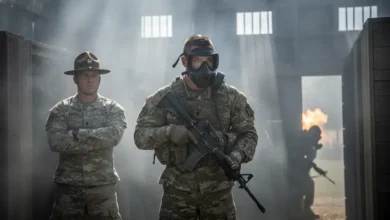
The Green Beret Gauntlet: A Guide to Special Forces Training & Requirements 🛡️
The Green Beret is not given; it is earned. It is forged in the crucible of the world’s most demanding military training pipeline, a journey designed to identify a rare breed of individual capable of operating at the highest levels of warfare, diplomacy, and intelligence. This path is not about who is strongest or fastest; it’s about who has the unshakeable character and mental fortitude to endure when everything else has been stripped away.
Many feel the call, but few understand the price of admission. This is your detailed brief. We will break down the exact requirements you must meet before you even begin and then walk you step-by-step through the grueling training pipeline.
This is not a story; it is a map of the gauntlet. Study it carefully. The journey to becoming a “Quiet Professional” begins with mastering this knowledge.
✅ The Foundation: Non-Negotiable Entry Requirements
Before you can face the challenges of the pipeline, you must pass through the first gate. These are the hard-line requirements that are checked by recruiters. There is no negotiating these points.
The Unshakeable Foundation: Who You Must Be
- Mental Fortitude 🧠: More than any physical trait, SF looks for unwavering mental toughness. You must be resilient, stable under extreme stress, and possess a “never quit” mindset.
- Adaptability: The nature of SF work is ambiguity. You must be a creative problem-solver who can thrive in chaotic, unstructured environments.
- Humility and Teamwork: Egos are a liability on a 12-man team. You must be a quiet professional—confident but humble, willing to learn, and fiercely committed to the success of your team over yourself.
The Hard Requirements: What You Must Have
This is the checklist. If you cannot meet every one of these, your journey stops here.
| Requirement | Details | Official Resource |
|---|---|---|
| Citizenship & Age | Must be a U.S. Citizen. Must be 20 years old by the time you reach the Q-Course (and no older than 36). | GoArmy Requirements |
| ASVAB Score | Minimum General Technical (GT) score of 110. This is non-negotiable and measures your aptitude for learning and problem-solving. | Official ASVAB Site |
| Physical Fitness | Must pass the Army Combat Fitness Test (ACFT) at a high level. You should be aiming to far exceed the minimums in every event. | The Official ACFT Site |
| Medical & Physical | Must pass a rigorous Special Operations medical physical. Vision must be correctable to 20/20. Must be able to qualify for Airborne School. | Recruiter & MEPS Assessment |
| Security Clearance | Must be eligible for and able to obtain a SECRET security clearance. This requires a clean criminal record and a stable personal history. | SF Recruiter Assessment |
Actionable Advice: Do not approach a recruiter until you are confident you can exceed these standards. Research and prepare for the ASVAB. Your physical fitness should be at its peak. This preparation demonstrates the initiative required of an SF candidate.
⛰️ The Gauntlet: The Special Forces Training Pipeline, Step-by-Step
This is the chronological path. Each step is a filter designed to test a different attribute.
Step 1: Foundational Soldiering (22 Weeks for 18X)
You must first be a master of the basics. For civilian 18X candidates, this means attending Infantry One Station Unit Training (OSUT). You will learn the core skills of an infantryman: advanced marksmanship, land navigation, and small unit tactics. For active-duty soldiers, this phase represents the experience you’ve already gained in your current MOS.
Step 2: Basic Airborne Course (3 Weeks)
All SF soldiers are paratroopers. At this course at Fort Moore, GA, you will prove your courage and ability to follow precise instructions by completing five successful static-line parachute jumps. It’s your ticket to Fort Bragg. 🪂
Step 3: Special Forces Preparation Course (SFPC) (4 Weeks)
At Fort Bragg, NC, you will attend a prep course specifically designed to get you ready for the main event: Selection. The focus is twofold:
- Physical Hardening: You will be pushed to your limits with intense PT, with a heavy emphasis on rucking and running to build the durability to live out of a rucksack.
- Land Navigation Mastery: This is a critical skill and a major point of failure. You will spend countless hours in the woods, day and night, mastering the map and compass. The Cadre expect perfection.
Step 4: The Crucible – Special Forces Assessment and Selection (SFAS) (21 Days)
This is the most infamous and misunderstood phase. SFAS is not training; it is a 21-day psychological and physical assessment to determine if you have the potential to be a Green Beret.
- The Goal: To strip you of all comforts and see your true character. The Cadre are looking for raw attributes: intelligence, physical endurance, motivation, and leadership potential.
- Key Events:
- Individual Performance: A battery of physical tests, obstacle courses, and runs. The most significant is the Star Course, an individual, long-distance land navigation event that tests your physical endurance, navigational skill, and mental resilience under extreme stress.
- Team Performance (“Team Week”): You are placed in a team of exhausted strangers and given ambiguous, physically demanding tasks (e.g., carrying heavy objects over long distances). The Cadre observe how you interact. Do you lead? Do you follow? Do you quit? Do you help others? Your ability to be a “good teammate” is paramount.
- The Outcome: You are either “Selected” or “Non-Select.” There is no feedback on why. If you are selected, you have earned a spot in the Qualification Course.
Step 5: The Special Forces Qualification Course (Q-Course) (6-12+ Months)
Selection proves you have the character. The Q-Course is where you acquire the skills. This is the professional schoolhouse for becoming a Green Beret, broken into distinct phases.
- Phase I & II – SF Doctrine & Small Unit Tactics (19 Weeks): You will learn the history and doctrine of SF and then master advanced small unit tactics, patrolling, and direct-action missions.
- Phase III – MOS Qualification (14-50 Weeks): You are assigned and trained in your specific SF job. This is where you become a specialist.
- 18B – Weapons Sergeant: Master of every weapon imaginable.
- 18C – Engineer Sergeant: Expert in demolitions and construction.
- 18D – Medical Sergeant: A brutally long and academic course, creating a medic with skills far surpassing normal standards.
- 18E – Communications Sergeant: Master of all communications, from satellites to field-expedient antennas.
- Phase IV – Unconventional Warfare (UW) – “Robin Sage” (4 Weeks): The legendary culminating exercise where you and your team are inserted into a fictional country to train and lead a guerrilla army.
- Phase V – Language and Culture (18-24 Weeks): You will attend language school to become proficient in a language assigned to your SF Group.
- Phase VI – SERE & Graduation: You will attend Survival, Evasion, Resistance, and Escape (SERE) school, followed by the Regimental First Formation, where you finally don the Green Beret.
🏋️ Physical Preparation: The Civilian’s Training Plan
You must show up over-prepared. Here is a baseline training philosophy.
| Fitness Area | Goal | Training Method |
|---|---|---|
| Rucking | To make carrying 50-75 lbs feel “normal.” | Start with 35 lbs for 4 miles. Progress slowly. Increase distance first, then weight. Your goal is to comfortably maintain a 15-minute/mile pace or faster. Mix in faster paces and heavier loads. This is the #1 priority. |
| Running | High aerobic capacity and endurance. | Focus on longer distances. Be able to run 5 miles in under 40 minutes (aim for 35). Mix in interval training (sprints) to increase your VO2 max. |
| Strength | Functional, durable strength. Not bodybuilding. | Focus on compound, full-body movements: Squats, Deadlifts, Overhead Press, and weighted Pull-ups. Grip strength is also crucial. |
| Injury Prevention | To survive the pipeline. | Foot Care is critical. Learn to treat blisters before they happen. Strengthen your hips, ankles, and core. Incorporate mobility and flexibility work (yoga, stretching) into your routine. |
Conclusion: The Price of Admission
The training and requirements to join the Army Special Forces are among the most demanding in the world. They are designed to find men and women who are not just physically strong, but who possess a rare combination of intelligence, adaptability, and an unbreakable will.
The path is a gauntlet, a series of trials that will demand everything from you. But it is a path with a clear structure. By understanding the requirements and the phases of training, you can transform an overwhelming dream into a series of achievable, albeit incredibly difficult, goals. Master the requirements, respect the process, and prepare your mind and body for the ultimate test.
❓ Frequently Asked Questions about SF Training & Requirements
Q1: What is the single biggest reason candidates fail SFAS?
A: While many people fail due to injuries or land navigation errors, the underlying reason is often a lack of mental fortitude. Candidates quit—either overtly by “tapping out,” or covertly by sandbagging on team events or intentionally failing a land navigation point. The physical stress is just a tool to expose a person’s true character and motivation.
Q2: How important is swimming?
A: Very. While it may not be the primary focus at SFAS, you will be required to pass several water survival and swimming tests throughout the pipeline, including full-uniform swims. You must be comfortable and competent in the water.
Q3: Can I choose my Special Forces MOS (18B, 18C, etc.)?
A: You can state a preference, and your civilian skills (e.g., a paramedic background for 18D) are taken into account. However, the final assignment is based on your test scores during the initial phases of the Q-Course, your performance, and, most importantly, the needs of the Army at that time.
Q4: Where can I find definitive, official information?
A: The only sources you should trust are official U.S. Army websites. Start with the U.S. Army Special Operations Recruiting (SORB) page. It has the most accurate and up-to-date information and is your gateway to speaking with a specialized recruiter.
Disclaimer: This information is for guidance and educational purposes. All U.S. Army training programs, standards, and requirements are subject to change. Always consult official U.S. Army sources and a recruiter for the most current information.